Описание
Тестовая часть
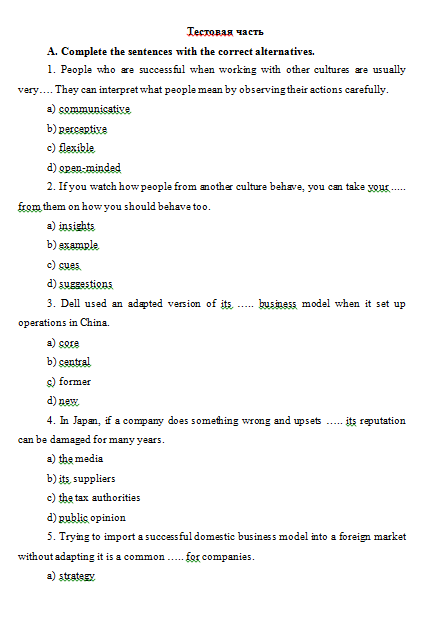
A. Complete the sentences with the correct alternatives.
1. People who are successful when working with other cultures are usually very…. They can interpret what people mean by observing their actions carefully.
а) communicative
b) perceptive
c) flexible
d) open-minded
2. If you watch how people from another culture behave, you can take your ….. from them on how you should behave too.
а) insights
b) example
c) cues
d) suggestions
3. Dell used an adapted version of its ….. business model when it set up operations in China.
а) core
b) central
c) former
d) new
4. In Japan, if a company does something wrong and upsets ….. its reputation can be damaged for many years.
а) the media
b) its suppliers
c) the tax authorities
d) public opinion
5. Trying to import a successful domestic business model into a foreign market without adapting it is a common ….. for companies.
а) strategy
b) goal
c) approach
d) pitfall
6. The best way to understand a new culture is to … yourself in it completely.
а) bury
b) maintain
c) experience
d) immerse
7. Young graduates often try to get a(n) ….. in a company abroad, so they can gain international experience.
а) appointment
b) work permit
c) work placement
d) workload
8. А ….. abroad is essential for people who want an international career.
a) practice
b) work
c) secondment
d) visit
9. Many companies in southern Europe have a …… structure, where all major decisions are taken at the top.20
a) heavy
b) formal
c) family
d) hierarchical
10. In overseas assignments, it is usually the spouse and family who find it difficult to ….. in the new country.
а) settle
b) remain
c) stay
d) perform
Чтение
A MIXED-CULTURE WORKFORCE
B. Understanding details.
Read the article and answer these questions.
11. In which country is Dillinger Hütte located?
12. What products does Dillinger Hütte produce?
13. How many people work at the Dillinger Hütte steel plant?
14. What is the proportion of German-speaking to French-speaking employees in the
workforce?
15. What two metaphors from cooking are used to describe the mix of cultures at Dillinger Hütte?
A melting pot for forging success
Peter Marsh March
A. Paul Belche uses a culinary metaphor to explain how he tries to coax the best qualities from the mix of cultures at the steel plant he runs in western Germany, close to the borders with France and Luxembourg.
B. “If you mix the yellow part of an egg with mustard and oil without being careful, you will produce something unexciting. But, if you pay correct attention to the details, you end up with the best mayonnaise,” he says.
C. He is explaining his approach to managing Dillinger Hütte, a global leader in specialist steels for applications such as oil pipelines. Mr Belche’s tactics for getting the best out of his employees provide wider lessons for managers of diverse workforces.
D. The company aims to take advantage of the different cultural characteristics of Saarland – the German state where it is based – that, over the centuries, has switched between French and German sovereignty.
E. Of the 5,500 employees in Dillinger, about 10 per cent have French as their mainlanguage, and the rest German. Mr Belche, a 56-year-old physicist, is from Luxembourg.
F. “The Germans are strong when it comes to practical work. The French are good at theory and we try to get the best of these two characteristics,” he says.
G. Mr Belche poses a question: “Who do you think would be better at plant safety – the German [speakers] or the French? You might think it would be the Germans. But actually it’s the French – they realise they are possibly behind in this field and so they work at it. Sometimes weakness can be a strength – as long as it’s recognised.”
H. His approach, he says, is to put teams of people from the different cultures together and encourage them to learn from each other. The factory follows the French approach to dining, with a siren announcing the end of the lunchtime break at 3pm, an hour later than is normal at other German steelworks. “This is to give us time for a decent lunch,” says Mr Belche.
I. When it comes to sales and technology, he says, the aim is to link the practical aspects of steelmaking and its applications, which he considers more German, and the theoretical, which he considers more French.
J. The interest in developing both sides extends to inviting groups of customers to Dillinger, not just to tour the steelworks for hands-on demonstrations of the equipment but also for scientific seminars of up to 300 people, where the accent is on ideas.
K. This mixing of the practical and theoretical must be linked to a single aim: making good products that will do a better job of solving customers’ problems, Mr Belche says.
L. In the tough business of making money out of steelmaking, it helps if companies can offer something special. In the effort to make this happen, the mix of cultures at Dillinger provides a soufflé of experiences, Mr Belche believes, that gives it a decent chance of success even in the current uncertain climate.
C. Word search
Find words and phrases in the article which fit these meanings.
16. to persuade, get something out of someone (paragraph A)
17. methods or plans for achieving something (paragraph C)
18. national rule over a country (paragraph D)
19. asks (a question) (paragraph G)
20. practical, with real experience (paragraph J)
21. difficult (paragraph L)
D. Sentence completion
Use words and phrases from the box in the correct form to complete these sentences.
to tour tough tactics hands-on to coax to link sovereignty
22. It’s quite popular for some manufacturing companies to encourage visitors to ……………….the plant.
23. About every decade, the steel industry goes through ……………times, when demand goes down.
24. You need to have good …………….to get different cultures to work well together.
25. The best way to learn a practical skill is to have lots of……………………. experience.
26. Managing a multicultural workforce well means trying to ……………………..the best out of the mix of cultures.
27. Good international managers are successful at………………. different cultures together.
28. Some parts of Europe have been under the …………………..of different countries during their history.
E. Word families
Write the nouns for each of these verbs.
29. explain
30. mix
31. solve
32. provide
33. recognise
Write the verbs for each of these nouns.
34 leader
35 weakness
36 strength
37 sale
38 success
F. Prepositions
Complete these sentences using the prepositions in the box.
at
at
between
from of
on
out of
out of
to
to
with
with
39. If you pay attention………………… details, you will get a good result.
40. The management skill is to mix one cultural group ………………another.
41. The French are generally better…………… theory.
42. Mr Belche wants to take advantage …………… the diversity of the workforce.
43. It’s important for the two cultures to learn…………………. each other.
44. By working ……………….something, you can become better.
45. If you invest the time and effort, you will end up ………………….something good.
46. When it comes……………….practical work, the Germans are stronger.
47. In the seminars held at Dillinger Hütte , the accent is……………… ideas.
48. Paul Belche wants to get the best ……………….his mixed-culture workforce.
49. Over the centuries, Saarland has switched ………………German and French sovereignty.
50. Making money………………..steelmaking is a tough job.
Список литературы