
Описание
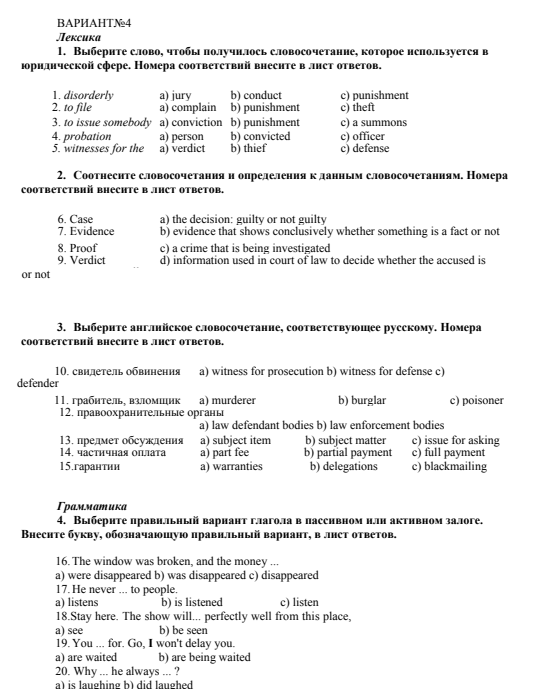
Лексика
1. Выберите слово, чтобы получилось словосочетание, которое используется в юридической сфере. Номера соответствий внесите в лист ответов.
1. disorderly a) jury b) conduct c) punishment
2. to file a) complain b) punishment c) theft
3. to issue somebody a) conviction b) punishment c) a summons
4. probation a) person b) convicted c) officer
5. witnesses for the a) verdict b) thief c) defense
2. Соотнесите словосочетания и определения к данным словосочетаниям. Номера соответствий внесите в лист ответов.
6. Case a) the decision: guilty or not guilty
7. Evidence b) evidence that shows conclusively whether something is a fact or not
8. Proof c) a crime that is being investigated
9. Verdict d) information used in court of law to decide whether the accused is
or not guilty
3. Выберите английское словосочетание, соответствующее русскому. Номера соответствий внесите в лист ответов.
10. свидетель обвинения a) witness for prosecution b) witness for defense c) defender
11. грабитель, взломщик a) murderer b) burglar c) poisoner
12. правоохранительные органы
a) law defendant bodies b) law enforcement bodies
13. предмет обсуждения a) subject item b) subject matter c) issue for asking
14. частичная оплата a) part fee b) partial payment c) full payment
15.гарантии a) warranties b) delegations c) blackmailing
Грамматика
4. Выберите правильный вариант глагола в пассивном или активном залоге. Внесите букву, обозначающую правильный вариант, в лист ответов.
16.The window was broken, and the money …
a) were disappeared b) was disappeared c) disappeared
17. He never … to people.
a) listens b) is listened c) listen
18.Stay here. The show will… perfectly well from this place,
a) see b) be seen
19. You … for. Go, I won’t delay you.
a) are waited b) are being waited
20. Why … he always … ?
a) is laughing b) did laughed
21.The fine hasn’t………..yet: we have no money.
a) paid b) was c) been paid
22. He will… in prison.
a) is put b) put c) be put
23. The auditors … already … all the necessary documents, and they can start their work,
a) were shown b) have been shown
24. Most books should…………….
a) have been tested b)be tested
25.The details of the contract should … much before signing it.
a) have been discussed b) be discussed
26. The police will… him sooner or later,
a) is arrested b) be arrested c) arrest
27. The tank … at the moment.
a) is filling b) is being filled
5. Выберите подходящий глагол в нужном времени. Внесите букву, обозначающую правильный вариант, в лист ответов.
28. For about 10 years legislators…………the bill.
a) have been discussing b) had discussing c) discussed
29. Last year he…………. this university.
a) finished b) had finished c) was finished
30. The police caught the man when he ………………… the shop.
a) robbing b) robed c) was robbing
31. In 1992 our country …………………… the treaty.
a) had ratified b) ratified c) was ratified
32 He already………….from the university.
a) graduated b) has graduated c) will graduate
33. The police ……….the killer yet.
a) didn’t find b) hasn’t found c) haven’t found
34. You look very thoughtful. What…………….about?
a) do you think b) are you thinking c) do
35. Students …………… law at the university.
a) are studying b) study c) have studied
a) graduated b) has graduated c) was graduated
36. He…………………… with the judge yet.
a) hasn’t yet talked b) haven’t talked c) hasn’t talked
37. Lawyers………………..to the agreement by the end of the present session.
a) came b) have come c) had come
38. Every year the State Duma of the RF ……………. a lot of laws.
a) was passing b) passes c) is passing
6. Выберите правильный вариант сравнительного оборота. Внесите букву, обозначающую правильный вариант, в лист ответов.
39.The document is……….concise ………….possible.
a) such…… as b) so ………..as c) as…….as
40 ……………. you work, …………..you study.
a) the better ………. the more b)the best ………… the better c)the more……….. the better
41. The period is twice…… long…………. a semester.
a) as longer……..as b) the c) as ….as
42. This method is…….effective ………….the previous one.
a) so………..as b)as…………as c) such ……………as
43……………you communicate with people,…………….. clients you have.
a)the better…….the best b) as……..as c) the better…….. the more
Чтение
7. Прочитайте текст и определите верны ли приведенные ниже утверждения (а — верно; b — не верно; с — информация в тексте отсутствует). Внесите букву, обозначающую
правильный вариант в лист ответов.
1. Every country has its own historically developing system of norms, legal institutions and
branches of law, which regulates different types of social relations. In order to understand different
aspects of a system of law it is necessary to look at various classifications of law, as branches of law
are traditionally considered to be the most important elements of this system. Numerous classifications
that vary from country to country usually reflect the peculiarities of different systems of law.
Nevertheless there are the most common divisions singled out by contemporary jurists. Thus law is
frequently classified into public and private and substantive and procedural.
The distinction is often made between public and private law. Public law governs the relationship
between the state and an individual, who is either a company or a citizen. Public law covers three
subdivisions: constitutional, administrative and criminal law. Constitutional law deals with the
structure of the government and the relations between private citizens and the government.
Administrative law deals with the decision-making of administrative units of government (for
example, tribunals, boards or commissions) in such areas as police law, international trade,
manufacturing, the environment, taxation, immigration and transport. Criminal law, or penal law, is
the body of law that relates to crime, i.e. illegal conduct that is prohibited by the state and sets out the
punishment to be imposed on those who break these laws. A crime is considered to be an offence
against the public, although the actual victim may be an individual. This is because the state considers
anti-social behaviour not simply as a matter between two individuals but as a danger to the well-being
and order of society as a whole. Private law is also known as civil law. It involves relationships
between individuals, or private relationships between citizens and companies. The main branches of
private law are contract, tort, family, employment and land law.
2. Contract law deals with legally binding agreements between people or companies that are
called parties to a contract. Tort law deals with civil wrongs which result in physical, emotional or
financial harm to a person or property. Tort cases comprise road accidents, defamation, product
liability (for defective consumer products), copyright infringement, environmental pollution (toxic
torts), etc. Family law is an area of the law that deals with family-related issues such as marriage and
divorce, adoption, custody of children, child abuse and alimony. Employment law is law relating to
the employment of workers, their contracts, conditions of work, trade unions and legal aspects of
industrial relations. Employment law is also called labour law. Land law is the law which deals with
rights and interests related to owning and using land. Land is the most important form of property, so
the name land law is often used for the law of property. The next classification which is widely used
is subdivision of law into substantive and procedural. There are many laws and legal rules found in
statutes, cases decided by courts (legal precedents) and other sources that are applied by courts in order
to decide lawsuits. These rules and principles of law are classified as substantive law. On the other
hand, the legal procedures that provide how lawsuit is begun, how the trial is conducted, how appeals
are filed, and how a judgment is enforced are called procedural law. In other words, substantive law
is the part of the law that defines rights, and procedural law establishes the procedures which enforce
and protect these rights. For example, two parties entered into a contract, but then one of the parties
breached this contract. The rules of bringing the breaching party into court and the conduct of the trial
are rather mechanical and constitute procedural law. Whether the agreement was enforceable and
whether the other party is entitled to damages are matters of substance and will be determined on the
basis of the substantive law of contract.
3. The system of law in the Russian Federation is presented by norms, institutions and
branches of law which together make a single unity. The system reflects social relations regulated by
specific norms and institutions of law. For example the problems of marriage and divorce, child
custody and adoption are connected with the sphere of family relations and consequently regulated by
the norms of family law. Branches of law are supposed to be one of the basic units in the whole system
of law. Each branch has its own peculiarities, which differentiate this very branch from the others, its
subject and method and its own place in the system. For years Russian jurists have made attempts to
classify branches of law. Nowadays there are different subdivisions that are used by contemporary
Russian scholars. Thus as well as in most other countries law in Russia is divided into public and
private, substantive and procedural, domestic and international. But there is one more classification
which is based on certain characteristics of Russian law. Traditionally Russian lawyers single out
fundamental, specialised and composite or complex branches of law. Fundamental branches regulate
the most general and important relations in different spheres of social life. This category involves
branches of substantive law such as civil law, criminal law, administrative law, as well as procedural
law including civil, criminal and administrative procedural law. Constitutional law doesn’t belong to
the group of fundamental branches. It is traditionally considered to have the leading position among
other branches, as the norms of constitutional law serve the basis for the norms of other branches.
Constitutional law in Russia concerns the structure of legislative, executive and judicial power and
principles of their work; the political system of the country; its federative structure; forms of property;
electoral system; legal status of citizens including their rights, duties and liberties. The main source of
constitutional law is the Constitution of the Russian Federation.
Specialised branches of law deal with special areas of social relations such as family relations,
financial relations, labour relations, etc. These branches are rather independent and their norms are
presented in special codes, for example the Family Code which is the primary source of family law;
the Labour Code which is known to be the source of employment law, the Land Code which is the
source of land law, etc. Together with fundamental and specialised branches there are so-called
composite branches. Usually these branches don’t have their own codes. The relations arising in these
spheres of law are usually regulated either by the norms of fundamental law i.e. administrative, civil
or criminal law or by norms of specialised law for example financial law. This group includes such
branches as business law, environmental law, maritime law, agricultural law, etc.
4. The jurists of all countries admit that it is necessary to differentiate between international
law and national law. The latter is also called domestic law or municipal law. Domestic law is the law
which is applicable within the boundaries of one state. International law is the body of legal rules that
regulate relations between sovereign states. It is a special system which is not a part of the national
law of the state. There are some important differences between international law and domestic law.
Domestic laws are passed by legislative bodies, most of which have popular political support.
International laws, on the other hand, are created by agreements between governments of different
states. As a result, they don’t have the support from individual citizens. Enforcement of international
laws is also different. Many international agreements or treaties are not binding; even when
nations agree to be bound, it is
197 unclear how obligations are to be enforced. Sometimes, especially at the time of conflicts, the
enforcement is provided by great powers. Countries differ greatly with regard to the importance
attached to international obligations. Some states consider international obligations superior to their
domestic laws, but in most cases international obligations are considered as a part of national law. The
Russian Federation has admitted the priority of international law over national law especially when it
comes to human rights and individual freedoms. The 1993 Constitution has confirmed the trend in
Russian practice of giving a prominent place to international legal standards in the domestic legal
setting. One of the principal aims of the Constitution is to clarify the status of international law in the
Russian domestic system of law.
The Constitution contains a special clause on the relationship between international law and
the Russian domestic law. Article 15 provides that the generally recognised principles and norms of
international law and the international treaties of the Russian Federation shall constitute an integral
part of its system of law. It also states that if an international treaty of the Russian Federation
establishes other rules than those stipulated by the law, the rules of the international treaty shall apply.
Two principal features of this article must be pointed out. Firstly, it states that international law is part
of the Russian domestic system of law. Secondly, it establishes a higher normative status for treaties
than for domestic laws. Consequently, legal regulations within Russia do not apply if their application
is incompatible with treaty provisions. The Constitution also includes Article 17 which provides that
human rights in Russia are recognised and ensured according to the generally recognised principles
and norms of international law. Thus, every citizen of the Russian Federation in case of violation of
their basic rights and freedoms has a right to apply to one of the international organizations, for
example to the European Court of Human Rights.
5. The study of law distinguishes between public law and private law, but in legal practice in
the UK the distinction between civil law and criminal law is more important to practising lawyers.
Public law relates to the state and is concerned with laws which govern processes in local and national
government conflicts between an individual and the state. Private law is concerned with the
relationships between individuals and corporations, and includes family law, contract law, property
law, etc. Criminal law deals with certain forms of conduct for which the state reserves punishment,
for example murder or theft. The state prosecutes the offender. Civil law concerns relationships
between private persons, their rights and duties. It also deals with the conduct which may give rise to
a claim by a legal person for compensation or injunction. When it comes to prosecution under the laws
of the country it’s common to speak about criminal offence but civil wrongs. Criminal and civil
proceedings are usually very different. In a criminal proceeding a prosecutor prosecutes a defendant.
If the verdict is “guilty”, the defendant is convicted. He will have a criminal record for the crime and
will be punished by one of a variety of punishments ranging from life imprisonment to a fine, which
is paid to a court. If the defendant is found “not guilty”, he is acquitted and allowed to leave court
without punishment. In civil cases a claimant sues a defendant or brings a claim against him. The
proceeding may result in judgement for the claimant, which means that the defendant is found liable
and the judge may order the defendant to pay damages. The duty to prove a case is called the burden
of proof. In criminal cases the burden of proof falls on the prosecution. In other words it’s the duty of
the prosecution to prove guilt, the defendant doesn’t have to prove his innocence. This principle is
called the presumption of innocence, which means that every person charged with a criminal offence
is considered to be innocent until proved guilty.
The degree of proof which makes the court sure that the person is guilty is called the standard
of proof. The standard of proof is higher in a criminal action than in a civil one since the penalties are
stricter. In a criminal case a prosecution must prove the guilt of a criminal “beyond reasonable doubt”,
which means that the prosecution must make the court sure that the defendant committed the crime. If
the court is not sure or has a reason for the doubt, it must acquit the defendant. In a civil action the
burden of proof is on the claimant. He is required to prove his case “on a balance of probabilities”, i.e.
to show that his case is more probable than not. But he doesn’t have to make the court sure about it;
it’s enough to show that the defendant was probably guilty. One and the same offence may sometimes
result in both kinds of prosecution, civil and criminal. For example, the driver who injured a passer by will not only face criminal penalties imposed by a criminal court but may have to pay compensation for injuries ordered by a civil court.
6. Labour Law is the body of laws, administrative rulings, and precedents which address the
legal rights of, and restrictions on, working people and their organizations. As such it mediates many
aspects of the relationship between trade unions and employers. Out of all different branches of law,
this one deals with the terms and conditions of work, and disputes regarding employment of labour.
This is a set of rulings and regulations that govern the relationship and terms between employers and
employees. In its most comprehensive sense the term includes social security and disability insurance
as well. In addition to the individual contractual relationships growing out of
the traditional employment situation, labour law deals with the statutory requirements and collective
relationships that are increasingly important in mass-production societies, the legal relationships
between organized economic interests and the state, and the various rights and obligations related to
some types of social services. The basic subject matter of labour law can be considered under nine
broad heads: employment; individual employment relationships; wages and remuneration; conditions
of work; health, safety, and welfare; social security; trade unions and industrial relations; the
administration of labour law; and special provisions for particular occupational or other groups. There
are special rules about the employment of children and young people. Your rights at work will depend
on: your statutory rights and your contract of employment. Statutory rights are legal rights based on
laws passed by Parliament. Nearly all workers, regardless of the number of hours per week they work,
have certain legal rights. The contract of employment is the agreement made between the employer
and the employee. This could be in the form of a written agreement or what has been agreed verbally
between them. In addition, the contract of employment will also include “custom and practice”
agreements. These are how things are usually done in the workplace, for example, if the employer
always gives the employees a day’s holiday in August. Even though this is not mentioned in the written
contract this will form part of the contract of employment as it is usual practice. If the written contract
says one thing, but in practice all the employees have been doing something else with the employer’s
knowledge and agreement, the “custom and practice” would form the contract rather than the written
statement.
7. A trade union may have negotiated an agreement with an employer about conditions at
work. The negotiated agreement will often form part of a contract of employment, particularly if the
conditions are more favourable than the previous ones. One of the main functions of trade unions is
to protect the rights of workers. All workers, regardless of the number of hours they work per week,
are entitled to receive a written statement from their employer, within two months of starting work.
The statement describes the main terms of the contract of employment. The statement must give details
about: job title, wages and hours of work, sick pay, pension schemes, holiday entitlement, grievance,
dismissal and disciplinary procedure and so on.
44. Classifications of law are the same in every country.
45. Domestic law is another name for national law.
46. Labour law does not deal with employment of labour.
47. Business law belongs to the category of specialised branches.
48. Criminal law is considered to be a branch of public law.
49. The category of fundamental branches in the Russian Federation includes only substantive law.
50. Law is classified only into public and private.
8. Переведите письменно 1 и 2 части текста