
Описание
Лексика
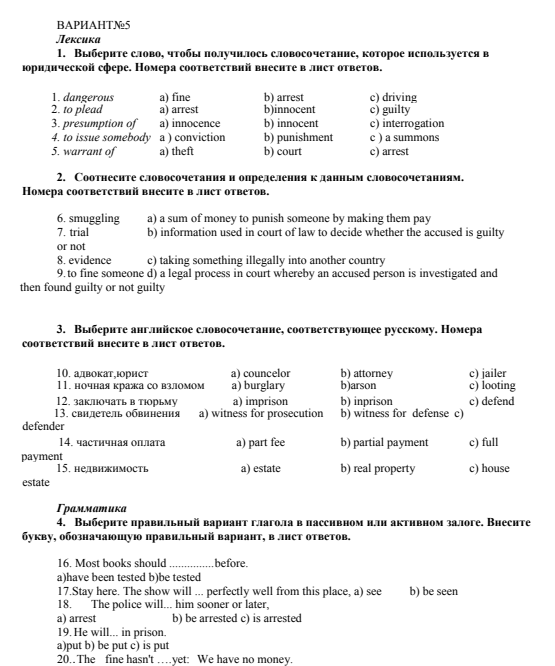
1. Выберите слово, чтобы получилось словосочетание, которое используется в юридической сфере. Номера соответствий внесите в лист ответов.
1. dangerous a) fine b) arrest c) driving
2. to plead a) arrest b)innocent c) guilty
3. presumption of a) innocence b) innocent c) interrogation
4. to issue somebody a ) conviction b) punishment c ) a summons
5. warrant of a) theft b) court c) arrest
2. Соотнесите словосочетания и определения к данным словосочетаниям. Номера соответствий внесите в лист ответов.
6. smuggling a) a sum of money to punish someone by making them pay
7. trial b) information used in court of law to decide whether the accused is guilty or not
8. evidence c) taking something illegally into another country
9.to fine someone d) a legal process in court whereby an accused person is investigated and then found guilty or not guilty
3. Выберите английское словосочетание, соответствующее русскому. Номера соответствий внесите в лист ответов.
10. адвокат,юрист a) councelor b) attorney c) jailer
11. ночная кража со взломом a) burglary b)arson c) looting
12. заключать в тюрьму a) imprison b) inprison c) defend
13. свидетель обвинения a) witness for prosecution b) witness for defense c) defender
14. частичная оплата a) part fee b) partial payment c) full payment
15. недвижимость a) estate b) real property c) house estate
Грамматика
4. Выберите правильный вариант глагола в пассивном или активном залоге. Внесите букву, обозначающую правильный вариант, в лист ответов.
16. Most books should ……………before. a)have been tested b)be tested
17.Stay here. The show will … perfectly well from this place, a) see b) be seen
18. The police will… him sooner or later, a) arrest b) be arrested c) is arrested
19. He will… in prison. a)put b) be put c) is put
20..The fine hasn’t ….yet: We have no money.
a) paid b) been paid c) was
21. You … for. Go, I won’t delay you.
a) are waited b) are being waited
22. The auditors … already … all the necessary documents, and they can start their work.
a) were shown b) have been shown
23. Why … he always … ?
a) is….. laughing b) did laughed
24. The window was broken, and the money …
a) disappeared b) was disappeared
25. He never … to people.
a) listens b) is listened c) listen
26. The details of the contract should … much before signing it.
a) have been discussed b) be discussed
27.The tank…at the moment.—
a) is filling b) is being filled
5. Выберите глагол в подходящем времени. Внесите букву, обозначающую правильный вариант, в лист ответов.
28. Every year the State Duma of the RF ……………..a lot of laws.
a) was passing b) passes c) is passing
29. You look very thoughtful. What…………….about?
a) do you think b) are you thinking c) do
30. He…………………… with the judge yet.
a) hasn’t yet talked b) haven’t talked c) hasn’t talked
31. In 1992 our country …………………… the treaty.
a) ratified b) had ratified c) was ratified
32. …………………………………………….. For about 10 years legislators the bill.
a) have been discussing b) had discussing c) discussed
33. The police caught the man when he…………………. the shop.
a) robbing b) robed c) was robbing
34. Students …………… law at the university.
a) are studying b) study c) have studied
35. Fast year he ………….from the university.
a) graduated b) has graduated c) was graduated
36. The police ……….the killer yet.
a) didn’t find b) hasn’t found c) haven’t found
37. He already………….from the university.
a) graduated b) has graduated c) will graduate
38. Lawyers………………..to the agreement by the end of the present session.
a) came b) have come c) had come
6. Выберите правильный вариант сравнительного оборота. Внесите букву, обозначающую правильный вариант, в лист ответов.
39. The period is twice……long………….a semester.
a) as longer……..as b) the c) as ….as
40 ………….. you communicate with people, ……………..clients you have.
a)the better …… the best b) as……….. as c) the better …………the more
41 ……………. you work, …………..you study.
a)the better ………. the more b)the best ………… the better c)the more……… the better
42.The document is………. concise ………….possible.
a) such…… as b) So …… as c) as…………. as
43. This method is…….effective ………….the previous one.
a) so………..as b)as…………as c) such ………..as
Чтение
7. Прочитайте текст и определите верны ли приведенные ниже утверждения (а — верно; b — не верно; с — информация в тексте отсутствует). Внесите букву, обозначающую
правильный вариант в лист ответов.
1. Crime is a breach of rules or laws for which some governing authority can ultimately
prescribe a punishment. Individual human societies may define crimes differently. Modem societies
generally regard crimes as offences against the public or the state. The word ‘crime’ is generally
associated with wrongdoing but not every type of wrongdoing is a crime. Telling lies is immoral wrong
but if telling lies is put into practice resulting in physical harm to another, then such action becomes
both criminal and immoral. There are some acts which are considered to be crimes in one country but
not in another. For example, it is a crime to have more than one wife at the same time in France, but
not in Indonesia. There are quite a lot of agreements among states as to which acts are criminal. But
such acts as stealing, physical attack or damaging somebody’s property will be unlawful in all
countries and the way of dealing with people suspected of crime may be different. Sometimes
government “creates” new crimes by identifying a form of behavior and passing a new law to deal
with it. Different societies or governments often review their ideas of what should and shouldn’t be a
crime.
There are three categories of crimes in the UK: indictable, summary, and either-way crimes.
Indictable offences are the most serious ones and are punishable by the longest prison terms. They
include murder, rape and robbery and can only be tried in the Crown Court. Summary offences are the
least serious ones, such as speeding and drunk-driving. Summary trials are heard in magistrates’
courts. Either-way offences can be heard either in the Crown Court or by magistrates. Examples of
either way offences include theft, drug offences and less serious physical violence. A magistrate can
decide that an either-way offence is serious enough to be heard in the Crown Court where the penalties
prescribed can be more severe. If, however, a magistrate decides that an either-way offence can be
heard as a summary trial, the defendant can choose to move the trial to the Crown Court.
2. An important aspect of criminal law is that in most crimes the prosecution has to prove two
elements. The first, actus reus, refers to the criminal act itself. The second, mens rea, refers to the
intent to commit a crime — ‘guilty mind’. However, in some cases, such as drunk driving or speeding,
the prosecution does not have to prove intent. Such offences are said to be of ‘strict liability’. Types
of serious crimes in most jurisdictions are: arson, theft, sexual offences, terrorism. In common law
arson is setting fire to the dwelling of another person. Theft sometimes is still known by the traditional
name of larceny which probably is the most common crime involving criminal intent. The traditional
definition of theft is the physical removal of an object without the consent of the owner. Burglary is
entering a building, inhabited vehicle or vessel to steal, to inflict bodily harm or to do unlawful
damage. In English law, any entry by an individual into a building with intent to commit theft is
burglary. Robbery is the commission of theft in circumstances of violence. Robbery takes many forms
— from the mugging of a stranger in the street to robberies of banks, involving numerous participants
and careful planning.
PRETRIAL STAGE. A criminal case passes through several phases before trial. At the first
stage the crime is reported and investigated. Then, if there is “probable cause”, i.e. reasonable grounds
(something more than mere suspicion to believe that a particular person committed the crime the
person can be arrested. An arrest warrant is necessary unless the pressure of time requires immediate
action (e.g. before the suspect flees). Finally, criminal charges must be lodged against the defendant.
Depending on the state, the charges are called either an indictment (by a grand jury) or information
(by a magistrate or police officer).They must be based on probable cause, preponderance of evidence,
or prosecutor’s evidence that supports a belief in the defendant’s guilt. In the USA most cases are
resolved without a trial. Attorneys for the defence and prosecution usually reach a plea bargain. The
judge must decide whether the guilty plea was freely given and
whether there was some factual basis for the plea, but judicial disapproval of an agreed upon plea is
rare. BURDEN OF PROOF. At the trial there is crucial difference between criminal and civil cases in
the level of proof required. A civil plaintiff merely needs a preponderance of the evidence; the judge
only needs to find that the evidence favours the plaintiff over the defendant. A successful criminal
prosecution requires proof of guilt beyond a reasonable doubt. The prosecuting counsel opens the case
with a short description of the events of the crime and calls his witnesses. After taking an oath by the
witness the prosecuting counsel begins his examination by asking the witness his/her name,
profession, place of domicile. In English law, witnesses are not allowed to make lengthy statements
to the court. It is the duty of the attorneys for both parties to examine and cross- examine witnesses.
THE ORDER OF PROCEEDINGS. The session is opened by the court called to order by the Clerk of
the Court. The judge enters. The clerk says: “All rise”. Everyone stands up and waits for the judge to
take his seat. The accused is brought into the dock and the clerk asks for his or her name. The accused
answers with the appropriate plea. In English law a person is innocent until proven guilty. This means
that in a trial the burden of proof is on the prosecution and if the prosecution cannot establish a
reasonable cause for conviction the court must acquit the accused. Both the defence and prosecution
give their closing arguments, the prosecution going first. The judge sums up the evidence and instructs
the jury on their duties. He reminds the jury that if there is any doubt at all in their minds they must
acquit the defendant. The jury retires to the jury room to consider the verdict. The verdict “not guilty”
does not necessarily mean that the judge or jury believe the defendant to be innocent. It is simply a
finding that there was insufficient evidence to prove guilt beyond a reasonable doubt. EVIDENCE.
Criminal trial courts have numerous, complex rules about what evidence is admissible, and how it
may be introduced. The rules are supposed to exclude irrelevant, unreliable, or unfairly prejudicial
matters, especially in jury cases (the system presupposes that a judge is less likely to be swayed by
improper evidence). The jury’s verdict is to be based solely on the evidence properly brought out at
the trial. Otherwise proper, highly relevant evidence may be excluded because it was obtained in
violation of a defendant’s constitutional rights. Criminal appeals are often decided on such so-called
technical issues. APPEALS. The appeal is a petition for review of a case that has been decided by a
court of law. The petition made to a higher court for the purpose of overturning the lower court’s
decision. The specific procedures for appealing can vary greatly depending on the type of case and
jurisdiction where the case was prosecuted. The appeal system is mostly for the benefit of the
defendant, but it is possible for the prosecution to appeal for a retrial. Appellate courts cannot overturn
a verdict simply because they disagree with it — e.g., with how the jury weighed the evidence and
decided to believe one witness more than another witness. Appeals tend to focus on problems in the
trial, judge’s legal ruling, the instructions to the jury, and the trial procedures, not simply in the judge’s
factual interpretations.
3. The Criminal Code of the Russian Federation is divided into a General Part, containing
general principles relating to criminal responsibility and assessment of punishment and a Special Part,
listing various offences and punishments. Under the General Part persons are subject to the criminal
law when they reach the age of sixteen years for normal crimes, and fourteen years for murder and
other grave crimes. Persons who are insane at the time of commission of a crime may not be convicted
thereof. The Criminal Code introduces some factors that exclude guilt to go along with traditional
justifications such as self-defence or necessity or excuses such as duress. These include “innocent
infliction of harm,” by persons who, due to objective or subjective (mental) circumstances, could not
have appreciated the danger of their acts or have prevented the harm or who inflict harm while taking
a socially useful justified risk. First-time offenders who commit less serious crimes can be freed of
criminal responsibility if they engage in “active remorse” in the form of turning themselves in, aiding
in the solving of the crime or making restitution.
4. The goal of punishment under the Code is the re-establishment of social justice,
rehabilitation of a convicted person, and prevention of the commission of new crimes. The Code
introduces life imprisonment as an alternative to the death penalty. The Special Part of the Criminal
Code contains a typical list of crimes against the person (homicide, sexual offences, assaultive
conduct). A special chapter is devoted to punishment of violations against “the constitutional rights
and freedoms of the person and citizen”, among them acts infringing on the inviolability of one’s
private life, correspondence, and dwelling or on the liberty of confession or assembly. Entrepreneurial
activity is protected by the Constitution and regulated by criminal law. Offences connected with
money laundering, restricting competition, false advertising, securities or credit fraud, fraudulent
bankruptcy, tax evasion, and consumer fraud are punished according to the criminal code. New
provisions provide for punishment for “ecological crimes” and “crimes in the sphere of computer
information”, including hacking and creating viruses. The present Code provides for responsibility for
environmental crimes, some relating to general violation of rules, others to improper handling of
dangerous substances such as biological agents or toxins, still others protecting distinct resources such
as water, the atmosphere, the sea, the continental shelf, the soil, the subsoil, and flora and fauna. Such
offences as incitement to national, racial, or religious hatred are punishable in accordance with the
present Criminal Code.
5. In a primitive society punishment was left to the individuals wronged and was vindictive or
retributive: in quantity and quality it would bear no special relation to the character or gravity of the
offence. Gradually there arose the idea of proportionate punishment of which the characteristic type
is “an eye for an eye”. In early times a superstitious belief in omens, ghosts, witchcraft was very
common. Superstitions maintained a grip on the lives of many people. It was tempting and easy to
blame almost any misfortune on somebody else, and sometimes senile old women were the target of
being accused of all kinds of witchcraft. “Witches” were frequently executed. Trial by ordeal is a
judicial practice by which the guilt or innocence of the accused is determined by subjecting them to
an unpleasant, usually dangerous experience. Indeed, the term ordeal itself has the meaning of
“judgment, verdict”. In some cases the accused were considered innocent if they survived the test or
if their injuries healed. In others, only death was considered proof of innocence. If the accused died
they were often presumed to have gone punishment. In medieval Europe trial by ordeal was considered
a procedure based on the premise that God would help the innocent by performing a miracle.
6. With the passage of time the attitude of society towards the excesses of the criminal law
gradually changed. The courts and the people themselves came to rebel against all the savagery. As to
the people, the last public execution in England took place in 1868, in front of Newgate Prison. The
condemned man was Michael Barrett, an Irish rebel sentenced for his part in a bomb attack. The crowd
sympathized with Barrett and was so hostile towards the hangman that the execution almost caused a
riot. From that time onwards all executions were held inside prisons. It was not until 1969 that the
death penalty for murder was finally abolished. Imprisonment has always been a favoured form of
punishment. For hundreds of years the Tower of London was regarded as the premier prison in the
land. The progress of civilization has resulted in a vast change in both the theory and in the method of
punishment. With the growth of law, the state took over the punitive function and provided itself with
the machinery of justice for the maintenance of public order. From that time crimes were against the
state, and such punishment as lynching became illegal. In the eighteenth century the humanitarian
movement began to teach the dignity of the individual and to emphasize rationality and responsibility.
The result was the reduction of punishment both in quantity and in severity, the improvement of the
prison system, and the first attempts to study the psychology of crime and to distinguish classes of
criminals with a view to their improvement. Later law breakers were considered as a product of social
evolution and cannot be regarded as solely responsible for their disposition to offences. Crime was
treated as a disease. Punishment, therefore, can be justified only if it either protects society or acts as
a deterrent, or when it aims at the moral regeneration of the criminal.
7. There are several kinds of punishment available to the courts. Crimes are punished
according to their seriousness. More serious crimes are given harsher penalties. In declaring a sentence
a judge may take into account the following: prior criminal record, the age of the offender and other
circumstances surrounding the crime, including cooperation with law enforcement officers, the
amount of loss to victims, whether a weapon was used in the crime, the age or helplessness of the
victims. Punishment may include:
• a fine
• term of imprisonment (time in jail or prison)
• probation or parole
• community service
For criminal offences FINES are often used when the offence is not a very serious one and
when the offender has not been in trouble before. For more serious crimes the usual punishment is
IMPRISONMENT. The length of sentences varies from a few days to a lifetime. However, a life
sentence may allow the prisoner to be released after a suitably long period if a parole board agrees that
his detention no longer serves a purpose. In some countries, such as the Netherlands, living conditions
in prison are fairly good because it is believed that deprivation of liberty is punishment in itself and
should not be so harsh that it reduces the possibility of the criminal re-educating and reforming
himself. In other countries, conditions are very bad. Perhaps because of an increase in crime or because
of more and longer sentences of imprisonment, some prison cells have to accommodate far more
people than they were built to hold. Britain and the United States are trying to solve the shortage of
space by allowing private companies to open prisons. PROBATION is the suspension of jail time. An
offender on probation is ordered to follow certain conditions set forth by the court, often under the
supervision of a probation officer. Offenders are ordinarily required to refrain from subsequent
possession of firearms, and may be ordered to remain employed, live at a directed place, obey the
orders of the probation officer. Offenders on probation might be fitted with an electronic tag (or
monitor), which signals their whereabouts to officials. Also, offenders have been ordered to submit to
repeated alcohol/drug testing or to participate in alcohol/drug or psychological treatment, or to perform
community service work. PAROLE is the supervised release of prisoners before the completion of
their sentence in prison. They may be returned to prison if they violate the conditions of their parole.
Conditions of parole often include things such as obeying the law, avoiding contact with the parolee’s
victims, obtaining employment, and maintaining required contacts with a parole officer. Parole should
not be confused with probation, as parole is serving the remainder of a sentence outside of prison,
where probation is given instead of a prison sentence and as such, tends to place more rigid obligations
upon the individual serving the term. CORPORAL PUNISHMENT is a form of physical punishment
that involves the deliberate infliction of pain as retribution for an offence, or for the purpose of
disciplining or reforming a wrongdoer. This kind of punishment is still employed in Malaysia,
Singapore, Pakistan, Zambia and Zimbabwe. Courts may sentence offenders to be caned or whipped.
As well as corporal punishment, some Islamic countries such as Saudi Arabia and Iran use other kinds
of physical penalties such as amputation or mutilation.
44. Only the prosecution attorneys give their closing arguments.
45. Men’s rea refers to the criminal act itself.
46. At the first stage of a criminal case before trial the crime is reported and investigated.
47. Such offences as ‘theft’ and ‘drug offences’ can only be heard in Magistrates’ courts.
48. One of the main principles of the English law is that a person is innocent until proven guilty.
49. The Criminal Code of the Russian Federation is divided into a General Part and a Code.
50. A person may be arrested if there is testimony of witnesses.
8. Переведите письменно 3 и 4 часть текста.