
Описание
Лексика
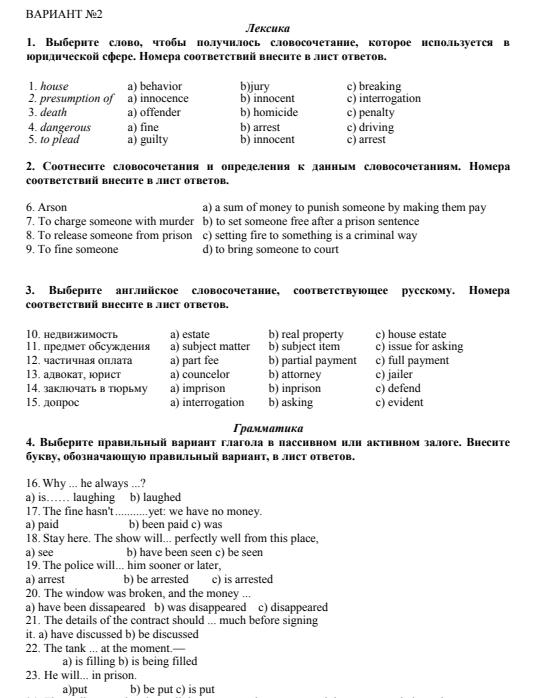
1. Выберите слово, чтобы получилось словосочетание, которое используется в юридической сфере. Номера соответствий внесите в лист ответов.
1. house a) behavior b)jury c) breaking
2. presumption of a) innocence b) innocent c) interrogation
3. death a) offender b) homicide c) penalty
4. dangerous a) fine b) arrest c) driving
5. to plead a) guilty b) innocent c) arrest
2. Соотнесите словосочетания и определения к данным словосочетаниям. Номера соответствий внесите в лист ответов.
6. Arson
7. То charge someone with murder
8. To release someone from prison
9. To fine someone
a) a sum of money to punish someone by making them pay
b) to set someone free after a prison sentence
c) setting fire to something is a criminal way
d) to bring someone to court
3. Выберите английское словосочетание, соответствующее русскому. Номера соответствий внесите в лист ответов.
10. недвижимость a) estate b) real property c) house estate
11. предмет обсуждения a) subject matter b) subject item c) issue for asking
12. частичная оплата a) part fee b) partial payment c) full payment
13. адвокат, юрист a) councelor b) attorney c) jailer
14. заключать в тюрьму a) imprison b) inprison c) defend
15. допрос a) interrogation b) asking c) evident
Грамматика
4. Выберите правильный вариант глагола в пассивном или активном залоге. Внесите букву, обозначающую правильный вариант, в лист ответов.
16.Why … he always …?
a) is…… laughing b) laughed
17.The fine hasn’t………..yet: we have no money.
a) paid b) been paid c) was
18. Stay here. The show will… perfectly well from this place,
a) see b) have been seen c) be seen
19.The police will… him sooner or later,
a) arrest b) be arrested c) is arrested
20. The window was broken, and the money …
a) have been dissapeared b) was disappeared c) disappeared
21. The details of the contract should … much before signing
it. a) have discussed b) be discussed
22. The tank … at the moment.—
a) is filling b) is being filled
23. He will… in prison.
a)put b) be put c) is put
24. The auditors … already … all the necessary documents, and they can start their work.
a) were shown b) have been shown
25.. Most books should before.
a) have been tested b)be tested
26. He never … to people.
a) Listens b) is listened c) listen
27. You … for. Go, I won’t delay you.
a) are waited b) are being waited
5. Выберите глагол в подходящем времени. Внесите букву, обозначающую правильный вариант, в лист ответов.
28. The police caught the man when he ………………… the shop.
a) robbing b) was robbing c) robed
29. In 1992 our country …………………… the treaty.
a) had ratified b) ratified c) was ratified
30. Every year the State Duma of the RF……………..a lot of laws.
a) was passing b) passes c) is passing
31. Last year he………….from the university.
a) was graduated b) graduated c) has graduated
32. You look very thoughtful. What…………….about?
a) are you thinking b) do you think c) do
33. He ………… to the university next year.
a) enroll b) will be enrolled c) be enrolled
34. The police ………. the killer yet.
a) didn’t find b) hasn’t found c) haven’t found
35. Students…………… law at the university.
a) are studying b) study c) have studied
36. For about 10 years legislators…………the bill.
a) discussed b) had discussing c) have been discussing
37. Lawyers ………………. to the agreement by the end of the present session.
a) had come b) have come c) came
38. He…………………… with the judge by 6 o’clock tomorrow.
a) haven’t talked b) will have talked c) hasn’t yet talked
6. Выберите правильный вариант сравнительного оборота. Внесите букву, обозначающую правильный вариант, в лист ответов.
39. Her resume is ……. clear………. required.
a) not as……..as b) as……….that c) more
40. The period is twice ….. long…………. a semester.
a) as longer…….. as b) the c) as … .as
41. The document is ……… concise…………. possible.
a) such…….as b) so ……….. as c) as ……….as
42 ……………..you work, …………..you study.
a) the better………. the more b) the best………… the better c) the more ………the better
43 ………….. you communicate with people, ……………..clients you have.
a) the better…… the best b) as……….. as c) the better ………..the more
Чтение
8. Прочитайте текст и определите верны ли приведенные ниже утверждения (а — верно; b — не верно; с — информация в тексте отсутствует). Внесите букву, обозначающую
правильный вариант в лист ответов.
1. A Constitution is a system which establishes the fundamental rules and principles which a
state will use to govern and regulate. There are several types of constitutions: written/unwritten,
rigid/flexible, federal/unitary. The term written constitution is used to describe a constitution that is
entirely written, that is codified in one single document. Written constitutions normally consist of a
ceremonial preamble, which sets forth the goals of the state and the motivation for the constitution,
and several articles containing the substantive provisions. The term unwritten constitution is used to
describe a constitution in which no single, formal document delineates the powers of a government.
Instead, an unwritten constitution comprises the body of a country’s laws, enacted over time, with an
emphasis on political precedent and parliamentary procedure, to create a framework in which a limited
government operates. Unwritten constitutions can contain written sources: e.g. constitutional statutes
enacted by the Parliament; and also unwritten sources: constitutional conventions, customs and
traditions. Many historians use the term “rigid” to describe the Constitution because in such
constitution there are provisions in writing that cannot be legally changed with the same ease and in
the same manner as ordinary laws. On the other hand, the Constitution is called “flexible ” because it
is an unwritten document that can be changed by an act of Parliament or through a process of
amendment. The federal constitution establishes the division of authority between the Federal
Government and the component units of the government. In a federal constitution, sovereignty is
invested in the central government. It allows a limited amount of government among units. The unitary
constitution relates to the parliament. It follows parliamentary system of power. The unitary
constitution establishes a unitary system of government where a central government does exist.
Although units are associated with that government, sovereignty is controlled by the central
government.
2. The Constitution of the Russian Federation is Russia’s supreme law, passed through a
national vote. It contains the basic principles of the Russian constitutional system. The Constitution:
defines the federative structure of the Russian Federation; establishes the principles of sovereignty and
independence of the Russian Federation; defines the principle of separation of powers between
legislative, executive and judicial branches; establishes equality of ideologies and religions; defines
the Russian Federation as a secular state.
The Constitution of the Russian Federation defines the rights and freedoms of a human and a
citizen, sets their priority when deciding any issues, and proclaims the principle of equality before law
and court. As for the federative structure, the Constitution contains the list of component units of the
Russian Federation, covers the issues that are within the jurisdiction of the Russian Federation and
those that are within the joint jurisdiction of federal and local authorities. Separate articles are devoted
to the bodies of federal power: the President of the Russian Federation, the Federal Assembly of the
Russian Federation, and the Government of the Russian Federation and also the judicial power of the
Russian Federation. In these articles, the order and the terms of appointed and elected officials and the
limits of their competence are defined according to the principle of separation of powers. Under the
Constitution adopted on December 12, 1993 at the all- Russia referendum, full authority in the Russian
Federation belongs to the President and the bodies of the legislative (two chamber parliament — Federal
Assembly), executive (Government of the Russian Federation) and the judicial authorities, which work
independently.
3. The President of the Russian Federation is the Head of the State; the duties of the President
are listed, including his status of the Supreme Commander of the Armed Forces of the Russian
Federation. The Constitution also contains the text of the oath taken by the President of the Russian
Federation upon taking office. The Federal Assembly of the Russian Federation (the Federation
Council and the State Duma) represents the legislature. The order of electing
representatives for these chambers, their competence, terms of office are provided by the Constitution.
The Government of the Russian Federation is the executive branch. The Constitution
determines the extent of its jurisdiction and also defines the order and the terms of office of
government officials. Judicial power is implemented by means of constitutional, civil, administrative,
and criminal legal proceedings. The Constitution establishes the principles of independence,
irremovability and immunity of judges, thus providing for objectiveness and impartiality of the court.
The system of courts of the Russian Federation consists of:
• the Constitutional Court of the Russian Federation;
• the Supreme Court of the Russian Federation;
• the Fligher Arbitration Court of the Russian Federation.
Separate articles are devoted to the Russian Federation Procurator’s Office with functions of
supervision and control, and the procedure for adoption of Constitutional amendments. The
Constitution regulates the issues of local self-government, including its authority and sphere of
activity. Transitional and Final provisions regulating the promulgation of the Constitution and its
enforcement are contained in Part 2 of the Constitution.
4. The US Constitution: The form of the US government is based on the Constitution of 1787
which was adopted after the War of Independence. The US Constitution consists of 7 articles and 27
amendments. The first 10 amendments are called the Bill of Rights and were adopted in 1791 under
popular pressure. The Bill of Rights is a series of limitations on the power of the United States federal
government, protecting the natural rights and liberties, property including freedom of religion,
freedom of speech, a free press, free assembly, and free association, as well as the right to keep and
carry arms. In federal criminal cases, it requires indictment by a grand jury for any capital crime,
guarantees a speedy, public trial with an impartial jury composed of members of the state in which the
crime occurred. A key feature of the US Constitution is federalism — the division of power between
the national government and the states. Another major feature of the Constitution is the principle of
the separation of powers within the national government. According to this principle the executive,
legislative and judicial branches exercise powers that are largely separate and distinct. There is not a
strict and complete separation of powers, the powers of the three branches overlap. Each branch has
its own responsibilities, but no branch has more power than the other branches. There is the system of
checks and balances. Under this principle each branch has certain duties to check the powers of the
other branches. This system was meant to protect against the extremes since it makes compromise and
consensus necessary. The legislative branch is called the Congress which consists of the Senate and
the House of Representatives. It is the responsibility of the Congress to propose and pass laws. In the
system of checks and balances, Congress can refuse to approve Presidential appointments and can
override presidential veto. The executive branch consists of the President, the Vice President, the
Cabinet and the 13 Departments, and also the independent agencies. Its responsibility is to enforce
laws. According to the principle of checks and balances, the President has the power of veto to reject
the bill of the Congress. He also appoints all Supreme Court Justices. The judicial branch consists of
the Supreme Court, 11 Circuit Courts of Appeals and 94 District Courts. This branch explains and
inteiprets laws and makes decisions in lawsuits. It has the power over the other two branches and
according to the principle of checks and balances can declare their actions and laws unconstitutional
in case they violate the principles of the Constitution.
5. All legislative Powers herein granted shall be vested in a Congress of the United States,
which shall consist of a Senate and House of Representatives. The House of Representatives shall be
composed of members chosen every second year by the people of the several states, and the electors
in each state shall have the qualifications requisite for electors of the most numerous branch of the
state legislature. No Person shall be a representative who shall not have attained to the age of twenty
five years, and been seven years a citizen of the United States, and who shall not, when elected, be an
inhabitant of that state in which he shall be chosen.
6. Representatives and direct taxes shall be apportioned among the several states which
may be included within this Union, according to their respective numbers, which shall be determined
by adding to the whole number of free persons, including those bound to service for a term of years,
and excluding Indians not taxed, three fifths of all other persons. The actual Enumeration shall be
made within three years after the first meeting of the Congress of the United States, and within every
subsequent term of ten years, in such manner as they shall by law direct. The number of representatives
shall not exceed one for every thirty thousand, but each state shall have at least one representative; and
until such enumeration shall be made, the state of New Hampshire shall be entitled to choose three,
Massachusetts eight, Rhode-Island and Providence Plantations one, Connecticut five, New-York six,
New Jersey four, Pennsylvania eight, Delaware one, Maryland six, Virginia ten, North Carolina five,
South Carolina five, and Georgia three. When vacancies happen in the representation from any state,
the executive authority thereof shall issue writs of election to fill such vacancies. The House of
Representatives shall choose their speaker and other officers; and shall have the sole power of
impeachment. The Senate of the United States shall be composed of two senators from each state,
chosen by the legislature thereof for six years; and each senator shall have one vote. Immediately after
they shall be assembled in consequence of the first election, they shall be divided as equally as may
be into three classes, the seats of the senators of the first class shall be vacated at the expiration of the
second year, of the second class at the expiration of the fourth year, and of the third class at the
expiration of the sixth year, so that one third may be chosen every second year; and if vacancies happen
by resignation, or otherwise, during the recess of the legislature of any state, the executive thereof may
make temporary appointments until the next meeting of the legislature, which shall then fill such
vacancies.
7. No Person shall be a senator who shall not have attained to the age of thirty years, and been
nine years a citizen of the United States, and who shall not, when elected, be an inhabitant of that state
for which he shall be chosen. The Vice President of the United States shall be President of the Senate,
but shall have no vote, unless they be equally divided. The Senate shall choose their other officers,
and also a President pro tempore, in the absence of the Vice President, or when he shall exercise the
Office of President of the United States. The Senate shall have the sole power to try all impeachments.
When sitting for that purpose, they shall be on oath or affirmation. When the President of the United
States is tried, the Chief Justice shall preside: And no person shall be convicted without the
concurrence of two thirds of the members present.
Judgment in cases of impeachment shall not extend further than to removal from office, and
disqualification to hold and enjoy any office of honor, trust or profit under the United States: but the
party convicted shall nevertheless be liable and subject to indictment, trial, judgment and punishment,
according to law. The times, places and manner of holding elections for senators and representatives,
shall be prescribed in each state by the legislature thereof; but the Congress may at any time by law
make or alter such regulations, except as to the places of choosing senators. The Congress shall
assemble at least once in every Year, and such Meeting shall be on the first Monday in December
unless they shall by law appoint a different day.
8. The British Constitution is unwritten unlike the constitution in America or the proposed
European Constitution, and as such, is referred to as an uncodified constitution in the sense that there
is no single document that can be identified as Britain’s constitution. The British Constitution can be
found in a variety of documents. The main ones are: Statutes (the Magna Carta of 1215 and the Act of
Settlement of 1701), Acts of Parliament; customs and traditions, political conventions, case law;
constitutional matters decided in a court of law. Since the English Civil War, the core principle of the
British constitution has traditionally been the doctrine of parliamentary sovereignty, according to
which the statutes passed by Parliament are the UK’s supreme and final source of law. It follows that
Parliament can change the constitution simply by passing new Acts of Parliament to be followed by
the Royal Assent. There is some debate about whether this principle remains entirely valid today, in
part due to the UK’s European Union membership. According to the doctrine of parliamentary
sovereignty, Parliament may pass any legislation that it wishes. There are
many Acts of Parliament which themselves have constitutional significance. For example, Parliament
has the power to determine the length of its own term. However, the Sovereign retains the power to
dissolve Parliament at any time on the advice of the Prime Minister. Parliament also has the power to
change the structure of its constituent Houses and the relation between them. Parliament consists of
the Sovereign, the House of Commons and the House of Lords. All the legislation must receive the
approval of the Sovereign (the Royal Assent). Following the accession of the UK to European
Economic Community (now the European Union) in 1972, the UK became bound by European law
and more importantly, the principle of the supremacy of European Union law. The House of Commons
alone possesses the power to pass a motion of no-confidence in the Government, which requires the
Government either to resign or seek fresh elections. Such a motion does not require passage by the
Lords, or the Royal Assent. Parliament traditionally also has the power to remove individual members
of the government by impeachment. By the Constitutional Reform Act2005 it has the power to remove
individual judges from office for misconduct. The executive power in the United Kingdom is exercised
by the Sovereign through Her Majesty’s Government. The monarch appoints the Prime Minister as the
head of Her Majesty’s Government in the United Kingdom. The Prime Minister then selects the other
Ministers which make up the Government. As in some other parliamentary systems of government,
the executive is accountable to Parliament.
9. The Courts of the United Kingdom are divided into three separate jurisdictions serving
England and Wales, Scotland and Northern Ireland, since the United Kingdom does not have a single
unified judicial system. The Constitutional Reform Act 2005 created a new Supreme Court of the
United Kingdom to take over the judicial functions of the House of Lords and devolution cases from
the Judicial Committee of the Privy Council. The Supreme Court began its work in 2009, and serves
as the highest court of appeal in England, Wales and in Northern Ireland, and for civil cases in
Scotland. The High Court of Justiciary remains the court of last resort in Scotland for criminal cases.
44. The British Parliament consists of the House of Commons and the House of Forces.
45. Another major feature of the US Constitution is the principle of the separation of powers within the national government.
46. The British Constitution can be found in a variety of documents.
47. The Constitution of the Russian Federation defines the rights and freedoms of a human and a citizen, sets their priority when deciding any issues, and proclaims the principle of equality
before law and court.
48. The President of the Russian Federation is the Head of the State of the Armed Forces.
49. The Government of the Russian Federation is the executive branch.
50. The first 11 amendments are called the Bill of Rights and were adopted under popular pressure.
10. Переведите письменно 4 и 5 абзацы текста.