
Описание
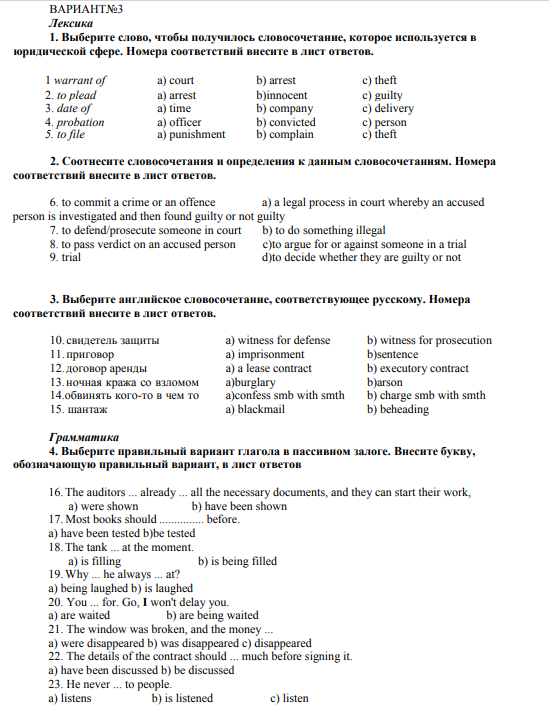
Лексика
1. Выберите слово, чтобы получилось словосочетание, которое используется в юридической сфере. Номера соответствий внесите в лист ответов.
1 warrant of a) court b) arrest c) theft
2. to plead a) arrest b)innocent c) guilty
3. date of a) time b) company c) delivery
4. probation a) officer b) convicted c) person
5. to file a) punishment b) complain c) theft
2. Соотнесите словосочетания и определения к данным словосочетаниям. Номера соответствий внесите в лист ответов.
6. to commit a crime or an offence a) a legal process in court whereby an accused person is investigated and then found guilty or not guilty
7. to defend/prosecute someone in court b) to do something illegal
8. to pass verdict on an accused person c)to argue for or against someone in a trial
9. trial d)to decide whether they are guilty or not
3. Выберите английское словосочетание, соответствующее русскому. Номера соответствий внесите в лист ответов.
10. свидетель защиты
11. приговор
12. договор аренды
13.ночная кража со взломом
14.обвинять кого-то в чем то
15. шантаж
a) witness for defense
a) imprisonment
a) a lease contract
a)burglary
a)confess smb with smth
a) blackmail
b) witness for prosecution
b)sentence
b) executory contract
b)arson
b) charge smb with smth
b) beheading
Грамматика
4. Выберите правильный вариант глагола в пассивном залоге. Внесите букву, обозначающую правильный вариант, в лист ответов
16.The auditors … already … all the necessary documents, and they can start their work,
a) were shown b) have been shown
17. Most books should …………… before.
a) have been tested b)be tested
18.The tank … at the moment.
a) is filling b) is being filled
19.Why … he always … at?
a) being laughed b) is laughed
20. You … for. Go, I won’t delay you.
a) are waited b) are being waited
21. The window was broken, and the money …
a) were disappeared b) was disappeared c) disappeared
22. The details of the contract should … much before signing it.
a) have been discussed b) be discussed
23. He never … to people.
a) listens b) is listened c) listen
24. Stay here. The show will… perfectly well from this place.
a) see b) be seen
25. The police will… him sooner or later,
a) is arrested b) be arrested c) arrest
26. The fine hasn’t………..yet: we have no money.
a) paid b) was c) been paid
27. He will… in prison.
a) is put b) put c) be put
5. Выберите подходящий глагол в нужном времени. Внесите букву, обозначающую правильный вариант, в лист ответов.
28. Students …………… law at the university.
a) have studied b) study c) are studying
29. Lawyers……………….. to the agreement by the end of the present session.
a) had come b) came c) have come
30. ………………………………………………………….. Every year the State
Duma of the RF ………………………………………………. a lot of laws.
a) passes b) was passing c) is passing
31. …………….. He to the university next year.
a) will be enrolled b) enroll c) be enrolled
32. In 1992 our country …………………… the treaty.
a) had ratified b) ratified c) was ratified
33. The police caught the man when he ………………… the shop.
a) robbing b) was robbing c) robed
34. For about 10 years legislators…………the bill.
a) had discussing b) discussed c) have been discussing
35. The police ……….the killer yet.
a) didn’t find b) hasn’t found c) haven’t found
36. He…………………… with the judge by 6 o’clock tomorrow.
a) b) haven’t talked b) will have talked c) hasn’t yet talked
37. You look very thoughtful. What…………….about?
a) are you thinking b) do you think c) do
38. Fast year he ………….from the university.
a) has graduated b) graduated c) was graduated
6. Выберите правильный вариант сравнительного оборота. Внесите букву, обозначающую правильный вариант, в лист ответов.
39. The period is twice……long………….a semester.
a) as longer……..as b) the c) as … .as
40.The document is………. concise ………….possible.
a) such…… as b) So……….. as c) as………. as
41.Her resume is ……. clear………. required.
a) not as……..as b) so ……….that c) more
42 ………….. you communicate with people, ……………..clients you have.
a)the better …… the best b) as……….. as c) the better ………..the more
43 ……………. you work, …………..you study.
a)the better ………. the more b)the best ………… the better c)the more……… the better
Чтение
7. Прочитайте текст и определите верны ли приведенные ниже утверждения (а — верно; b — не верно; с — информация в тексте отсутствует). Внесите букву, обозначающую
правильный вариант в лист ответов.
1. The judicial system of the Russian Federation consists of courts at the federal level and regional. Courts. Courts at the federal level The Constitutional Court. This is the highest judicial body in the Russian Federation. It is made up of 19 judges, proposed by the President of the Russian Federation and approved by the Federation Council. Since June 2008 the Constitutional Court has been located in St Petersburg. The Constitutional Court has jurisdiction to interpret the RF Constitution; to decide whether a federal law is consistent with the country’s Constitution; and to adjudicate whether or not laws regulations and normative acts passed by the President of the Russian Federation, the Council of the Federation, the State Duma, the Government of the Russian Federation, constitutions of republics, charters and other normative acts of the subjects of Russian Federation are consistent with the Constitution of the Russian
Federation; Courts of General Jurisdiction. The Supreme Court of the Russian Federation. This is the supreme judicial body for all courts of general jurisdiction on civil, criminal and administrative matters. As of today the Supreme Court consists of 123 judges. Judges for the Supreme Court are proposed by the President of the Russian Federation and approved by the upper house of the legislature, the Federation Council. The Supreme Court is located in Moscow. It has jurisdiction as a court of cassation, i.e. it is the highest court of appeal in the land. It is a court of supervisory instance over the courts of the subjects of the Russian Federation and over the tier of district courts below that level. There are three chambers in the structure
of the Supreme Court of the Russian Federation: Judicial Chamber on Civil Cases; Judicial Chamber on Criminal Cases; and Military Chamber. The Plenary Session of the Supreme Court can issue regulations. Regulations are a unique element of the machinery for the implementation of domestic law in the Russian legal system. Enacted by the Plenary Session, they are “explanations on issues of judicial practice”, based on the overview and generalization of the jurisprudence of the lower courts and Supreme Courts of subjects of the Federation. Regulations are abstract opinions but legally binding on all lower courts. They summarize the judicial practice of lower courts and explain how a particular provision of the law shall be applied. These regulations are employed to ensure the consistent application of Russian law by explaining how the law shall be interpreted. Regulations have their legal basis in Article 126 of the RF Constitution. Military Courts. The basic tier of military courts is the military courts of the armed forces, fleets, garrisons and separate military forces. The middle tier of military courts consists of military courts of the branches of the armed forces, the seven Military Districts into which the country is divided, and the districts of anti-aircraft defense, navy and individual armies. They consider disputes involving military personnel. Three-tiered system of the military courts is an integral part of Courts of General Jurisdiction. Arbitration Courts. Arbitration courts form a system with jurisdiction over economic disputes that, as a rule, arise between companies and individual entrepreneurs, both Russian and foreign. The Higher Arbitration Court of the Russian Federation. Judges for the Higher Arbitration Court are proposed by the President of the Russian Federation (Article 127 of the Constitution) and approved by the Federation Council. It exercises original jurisdiction over disputes between the Russian government and commercial parties, the government and subjects of the Russian Federation, or between subjects of the Russian Federation. The Plenary Session of the Higher Arbitration Court can also issue Regulations. Regional courts Constitutional Courts (or Charter Courts) of the Subjects of the Russian Federation with the jurisdiction to interpret Regional Constitutions and Charters and decide whether local statutes are consistent with Regional Constitutions and Charters. Courts of the subjects of the Russian Federation. These include the Supreme Courts of the Republics, the highest Courts of each Region, the Moscow and Saint-Petersburg City Courts, and the courts of autonomous districts. Courts of the subjects of the Russian Federation serve as courts of cassation and extraordinary appeal from their subordinate district courts. Their original jurisdiction constitutes challenges to normative laws and regulations of the regional authorities, and adoption of regulations. There are district courts located in the country’s smaller towns and rural administrative areas including groups of villages; cities have several courts of that kind. District courts are the basis of the system of courts of general jurisdiction, with jurisdiction over the overwhelming majority of civil and criminal cases, unless otherwise provided by law. As courts of appeal, district courts decide appeals from justices of the peace. Justices of the peace form an integral part of the system of courts of general jurisdiction, although they are considered to be regional judges. They handle minor civil disputes, petty administrative and criminal offences. Appeals against decisions of justices of the peace go to district courts, the decisions of which are final. In each district there may be several justices of
the peace. Arbitration Courts. Ten Federal District Arbitration Courts act as courts of cassation. The Appellate Courts consider appeals as a rehearing with new evidence. The Arbitration Courts of the subjects of the Russian Federation consider the absolute majority of economic disputes.
2. The judicial system in the United States is dual: it consists of the federal court system and the state court systems. The federal courts are concerned with cases arising under federal law, and the state courts with cases arising under state law. While each court system is responsible for hearing certain cases, neither is completely independent of the other, and the systems often interact. Furthermore, solving legal disputes and vindicating legal rights are key goals of both court systems. The U.S. Constitution created a governmental structure for the United States known as federalism. Federalism refers to a sharing of powers between the national government and the state governments. The Constitution gives certain powers to the federal government and reserves the rest for the states. Therefore, while the Constitution states that the federal government is supreme with regard to those powers expressly or implicitly delegated to it, the states remain supreme in matters reserved to them. This supremacy of each government in its own sphere is known as separate sovereignty, meaning each government is sovereign in its own right.
Both the federal and state governments need their own court systems to apply and interpret their laws. Furthermore, both the federal and state constitutions attempt to do this by specifically
spelling out the jurisdiction of their respective court systems. For example, since the Constitution gives Congress sole authority to make uniform laws concerning bankruptcies, a state court would lack jurisdiction in this matter. Likewise, since the Constitution does not give the federal government authority in most matters concerning the regulation of the family, a federal court would lack jurisdiction in a divorce case. This is why there are two separate court systems in America. The federal court system deals with issues of law relating to those powers expressly or implicitly granted to it by the U.S. Constitution, while the state court systems deal with issues of law relating to those matters that the U.S. Constitution did not give to the federal government or explicitly deny to the states.
The term “federal court” can actually refer to one of two types of courts. The first type of court is what is known as an Article III court. These courts get their name from the fact that they derive their power from Article III of the Constitution. These courts include the U.S. District Courts, the U.S. Circuit Courts of Appeal, and the U.S. Supreme Court. They also include two special courts: the U.S. Court of Claims and the U.S. Court of International Trade. These courts are special because, unlike the other courts, they are not courts of general jurisdiction. Courts of general jurisdiction can hear almost any case. All judges of Article III courts are appointed by the President of the United States with the advice and consent of the Senate and hold office during good behavior. The second type of court also is established by Congress. These courts are magistrate courts, bankruptcy courts, the U.S. Court of Military Appeals, the U.S. Tax Court, and the U.S. Court of Veterans’ Appeals. The judges of these courts are appointed by the President with the advice and consent of the Senate. They hold office for a set number of years, usually about 15. Magistrate and bankruptcy courts are attached to each U.S. District Court. The U.S. Court of Military Appeals, U.S. Tax Court, and U.S. Court of Veterans’ Appeals are called Article I or legislative courts.
3. U.S. District Courts. There are 94 U.S. District Courts in the United States. Every state has at least one district court, and some large states, such as California, have as many as four. Each district court has between 2 and 28 judges. The U.S. District Courts are trial courts, or courts of original jurisdiction. This means that most federal cases begin here. U.S. District Courts hear both civil and criminal cases. In many cases, the judge determines issues of law, while the jury (or judge sitting without a jury) determines findings of fact. U.S. Circuit Courts of Appeal. There are 13 U.S. Circuit Courts of Appeal in the United States. These courts are divided into 12 regional circuits and sit in various cities throughout the country. The U.S. Court of Appeals for the Federal Circuit (the 13th Court) sits in Washington. These courts will examine the trial record for only mistakes of law; the facts have already been determined by the U.S. District Court. Therefore, the court usually will neither review the facts of the case nor take any additional evidence. When hearing cases, these courts usually sit in panels of three judges. U.S. Supreme Court. The Supreme Court of the United States is the highest court if the nation and the court of last resort. It consists of a Chief Justice and eight associate justices, all of whom are appointed for life by the President with the advice and consent of the Senate. The main duty of the Supreme Court is to decide whether laws passed by Congress agree with the Constitution. Sitting as a court of first instance it considers cases connected with religion, privacy rights, race and sex discrimination. Special Article III Courts. 1. U.S. Court of Claims: This court sits in Washington, D.C., and considers cases involving suits against the government. 2. U.S. Court of International Trade: This court sits in New York and hears cases involving tariffs and international trade disputes. Special Courts Created by Congress. 1. Magistrate judges: These judges deal with certain criminal and civil matters, often with the consent of the parties. 2. Bankruptcy courts: These courts hear cases arising under the Bankruptcy Code. 3. U.S. Court of Military Appeals: This court is the final appellate court for cases arising under the Uniform Code of Military Justice. 4. U.S. Tax Court: This court considers cases arising over alleged tax deficiencies. 5. U.S. Court of Veterans’ Appeals: This court handles certain cases arising from the denial of veterans’ benefits. No two state court systems are exactly alike. Nevertheless, there are sufficient similarities to provide an example of what a typical state court system looks like. Most state court systems are made up of two sets of trial courts: trial courts of limited jurisdiction (probate, family, traffic, etc.) and trial courts of general jurisdiction; intermediate appellate courts and the highest state courts. Unlike federal judges, most state court judges are not appointed for life but are either elected or appointed for a certain number of years.
Trial Courts of Limited Jurisdiction. Trial courts of limited jurisdiction are courts that deal with only specific types of cases. They are usually presided over by a single judge. Some examples of trial courts of limited jurisdiction include: 1. Probate court: This court considers cases concerning administration of estates. It sees to it that the provisions of a will are carried out properly or sees to it that a decedent’s property is distributed according to the state law. 2. Family court: This court hears cases concerning adoption, divorce, alimony, child custody etc. 3. Traffic court: This court usually considers minor violations of traffic laws. 4. Juvenile court: This court usually deals with cases involving delinquent, unruly or neglected children and adults who neglect, abuse or contribute to the juvenile delinquency. 5. Small claims court: This court usually resolves suits between private persons of a relatively low dollar amount, for example, less than $5,000. 6. Municipal court: This court usually considers cases involving offenses against city ordinances. Trial Courts of General Jurisdiction. Trial courts of general jurisdiction bear the main burden in the administration of justice. They hear cases outside the jurisdiction of the trial courts of limited jurisdiction. These involve both civil and criminal cases. One judge (often sitting with a jury) usually hears them. In such cases, the judge decides issues of law, while the jury decides issues of fact. Intermediate Appellate Courts. Many, but not all, states have intermediate appellate courts between the trial courts of general jurisdiction and the highest court in the state. Any party, except in a case where a defendant in a criminal trial has been found not guilty, who is not satisfied with the judgment of a state trial court may appeal the matter to an appropriate intermediate appellate court.These courts usually sit in panels of two or three judges and review cases appealed from trial courts todetermine if the law was correctly interpreted and applied. Highest State Courts. All states have some sort of highest court. While they are usually referred to as supreme courts, some, such as the highest court in Maryland, are known as courts of appeal. In states with intermediate appellate courts, the highest state courts usually have discretionary review as to whether to accept a case. In states without intermediate appellate courts, appeals may usually be taken to the highest state court as a matter of right. In addition, many state supreme courts have original jurisdiction in certain matters. For example, the highest courts in several states have original jurisdiction over controversies regarding elections and the reapportionment of legislative districts.
44. The Constitutional Court has jurisdiction to interpret the RF Constitution; to decide whether a federal law is consistent with the country’s Constitution; and to adjudicate whether or not
laws and regulations passed by the Republic of the Russian Federation are consistent with the RF Constitution.
45. The Plenary Session of the Supreme Court can issue laws.
46. The judicial system in the United States consists of the federal court system and the state court systems.
47. Bankruptcy courts hear cases arising under the Uniform Code.
48. The federal and state governments require separate court systems to enforce and interpret laws.
49. U.S. Circuit Courts of Appeal are divided into 12 regional circuits and sit in various cities throughout the country.
50. The Arbitration Courts of the subjects of the Russian Federation consider the little majority of economic disputes.
8. Переведите письменно 2 часть текста.