
Описание
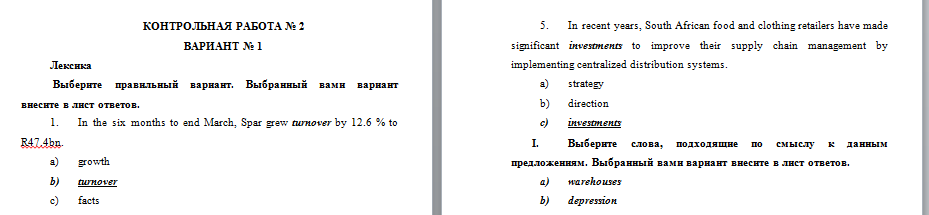
Лексика
Выберите правильный вариант. Выбранный вами вариант внесите в лист ответов.
1. In the six months to end March, Spar grew turnover by 12.6 % to R47.4bn.
a) growth
b) turnover
c) facts
2. In essence, Spar warehouses and distributes groceries and other products to mainly independent retailers that use the Spar brand.
a) retailers
b) customers
c) staff
3. Other advantages for independent owners include access to competitively priced products, benefitting from the Spar Group’s economies of scale.
a) reason
b) owners
c) disadvantage
4. The recent convertible bond issue by Impala Platinum shows just how tough it is as the company issued these new bonds for an amount that is equal to over 10 % of its market cap.
a) used
b) looked for
c) issued
5. In recent years, South African food and clothing retailers have made significant investments to improve their supply chain management by implementing centralized distribution systems.
a) strategy
b) direction
c) investments
I. Выберите слова, подходящие по смыслу к данным предложениям. Выбранный вами вариант внесите в лист ответов.
a) warehouses
b) depression
c) expenditure
d) savings
e) a wholesaler
6. We deal directly with the manufacturer, without using a wholesaler.
7. The country entered a period of economic depression.
8. We cannot do the costing until we have details of all the production expenditure.
9. These warehouses are usually closed to the public.
10. We put our savings into a building society or into a building society account.
II. Подберите данным словам соответствующее определение. Выбранный вами вариант внесите в лист ответов.
11. refund – e) money that is returned to a buyer because he or she no longer wants the product
12. gross domestic product (GDP) – d) the overall output of goods and services produced within the country
13. perk – b) a benefit you receive from your job, such as a company car or gym membership
14. benchmarking – a) a method of investigating successful techniques in an industry and comparing them to one’s own business
15. consumer – c) a person who buys and uses products sold by someone else
Грамматика
III. Измените данное вам слово, вставьте в предложение. Выбранный вами вариант внесите в лист ответов.
16. She’s got the wonderful ability to make people feel at home.
17. The new industrial estate will create new jobs.
18. He’ll find it hard to work in the banking business. It’s a competitive world.
19. Avatar in 3D was the most successful film of the year in 2009.
20. He’s travelled a lot and tells fascinating stories about his adventures.
IV. Выберите соответствующую грамматическую форму английского глагола. Выбранный вами вариант внесите в лист ответов.
21. I wrote last week about how we can use our small portfolio sizes to outperform the professionals.
a) write
b) wrote
c) written
22. As consumption increases, it becomes more important for manufacturers, retailers and logistics providers to get their products to consumers timorously, efficiently and safely.
a) becomes
b) was become
c) have become
23. Honeywell is considered one of the world leaders in this space.
a) considers
b) considered
c) will considered
24. Property is a long-term game, with analysts often encouraging investors to hold a long-term view and to ride out volatility
a) encourage
b) encourage
c) encouraging
25. The US have all launched new visas and put in place policies to make it easier for start-ups and entrepreneurs to start businesses within their national borders
a) launched
b) launching
c) launch
26. Canada is acknowledged as one of the most attractive countries for entrepreneurs
a) acknowledge
b) acknowledges
c) acknowledged
27. If they manage to secure this, they can apply for the visa.
a) could
b) can
c) was able to
28. The start-ups need to have been founded in the past three years in the US and demonstrate a potential for growth and job creation.
a) founding
b) found
c) founded
29. She says success is often dependent on having a very innovative, high-growth business idea that has high export potential.
a) have
b) has
c) had
30. The workspaces normally include the traditional open-plan areas with “hot desks”, as well as dedicated desks for individuals.
a) include
b) including
c) has included
31. Previous success does not automatically translate into success in the next venture.
a) do not
b) does not
c) has not
32. Historically, its exposure to risk assets has been limited to 50 % of the portfolio, with the current level at about 35 %.
a) limit
b) limited
c) limits
V. Выберите верный вариант. Выбранный вами вариант внесите в лист ответов.
33. He wrote the number down in order not to forget it.
a) in order not to
b) as soon as
c) till
34. Despite needing a rest, the team continued to work.
a) In spite
b) Despite
c) Although
35. Although trade restrictions might help a country for a short period of time, their overall effect is a negative one.
a) Although
b) Whether
c) Later
36. I work as a telesales operator in a call centre, which is a boring job.
a) after
b) which
c) until
37. He wasn’t wearing a coat, even though it was very cold.
a) whereas
b) even though
c) despite
38. It was very late. Nevertheless, the guests didn’t leave.
a) By the way
b) Certainly
c) Nevertheless
VI. Выберите правильную форму глагола. Выбранный вами вариант внесите в лист ответов.
39. If he pays me tonight, I’ll have enough money for the tickets.
a) isn’t pay
b) pays
c) paid
d) had paid
40. It was rather a dull game so I left before the end; if I had waited another five minutes, I would have seen Chelsea scoring a really exciting goal.
a) would see
b) saw
c) had seen
d) would have seen
41. I shouldn’t drink that wine if I were you.
a) am
b) were
c) would be
d) had been
42. If I can find a cheap room, I’ll stay a fortnight.
a) can
b) had to
c) must
d) could
43. If he knew that it was dangerous, he wouldn’t come.
a) didn’t come
b) not came
c) wouldn’t come
d) will not come
Чтение
VII. Прочитайте текст и определите, верны ли приведённые ниже утверждения (А – верно; В – неверно). Выбранный вариант внесите в лист ответов
Goodbye to the golden age of global brands
1) In the Harvard Business School professor Theodore Levitt’s seminal paper The Globalization of Markets, written in 1983, he argued that, as new media and technology shrank the world, people’s tastes would converge, creating a single global market that would be dominated by the world’s most successful brands. So, when the Berlin Wall fell and the barriers to world trade came down, it seemed Prof Levitt would be proved right. Global brand owners poured into the newly opened markets and, facing little competition in countries unaccustomed to consumer culture, they thought they would clean up. Then, some awkward commercial realities started to close in.
2) Once local consumers had tried these new products, they found them far too expensive to buy on a regular basis, even if they liked them. And soon, local producers sprang up offering much better value for money with products of only slightly inferior quality at a 30 vastly lower price. Usually, too, these products were better suited to local tastes and cultural preferences than those being foisted onto consumers by the global corporations. The global brand owners were left spreading their advertising and other fixed costs over tiny market shares and often faced extra costs, such as tariffs.
3) In many of these countries today, global brand owners command the super-premium end of the market in any given product category, while local brands command the rest. The global brand owners could try to move into the mass market by creating low-price products designed to suit local tastes, but that would throw them into head-on competition with local companies possessing better distribution channels and a far deeper understanding of the market. Increasingly, therefore, they have resorted to buying local brands and the companies that own them. And here, of course, lies the paradox. Whatever is the point of owning a global brand if it does not work in global markets?
4) Let us be optimistic and suppose the poor countries do become rich. But what do we see happening in rich countries? Ever-proliferating brand choices. There are more soft drink brands than there have been for years, more fast food chains, more packaged goods, more cars. Supermarkets are competing with brand owners by selling own-label products that are as good as the branded version but cost 20-30 per cent less.
5) Global brands, of course, are not about to disappear. But it must now be clear that Prof Levitt was mistaken in believing the world’s tastes would converge on standardized products. Everything we have learned about consumerism over the decades shows that, as people become better off, they want more choices, not fewer. Global brands may be here to stay, but their golden age is over.
44. When the Berlin Wall fell and the barriers to world trade came down, Professor Levitt was proved right.
45. Shortly after that time, local producers in countries with newly opened markets began supplying similar products to global brands at a much more attractive price.
46. Currently global brand products sell best as luxury products in many of these countries.
47. In rich countries there are fewer brand choices in supermarkets.
48. The more money consumers have, the more choices they want.
49. Supermarkets are competing with brand owners by selling own-label products.
50. Prof Levitt claimed that the world’s tastes would change every decade.
VIII. Переведите письменно 2, 3, 4, абзацы текста
Список литературы